
Price mainly by agent seat and the invoice tracks entitlement, not acceptance.

Upstream meters are not buyer meters. OpenAI's Agents API bills model, tool, and container usage while the vendor manages sessions, orchestration, compaction, and recovery. Google's Gemini 3.8 Flash intro pricing sits at $0.75/M input and $3.75/M output, and the model may burn extra tokens and tool calls on harder jobs. Anthropic's redesigned Projects warn that parallel workers can hit usage limits faster. Those are cost lines. The buyer still wants finished work that survives a check.
That gap is the commercial problem. Price mainly by agent seat and the invoice tracks entitlement, not acceptance. Tokens, containers, and minutes move under the seat. Completed jobs do not.
A seat used to mean one named operator doing bounded work. That mapping is broken. Anthropic's Projects coordinator "scopes the request, delegates the work, coordinates parallel threads, reviews the outputs, and assembles the finished result," with each worker a full session on its own branch. OpenAI's Agents API adds managed harness features plus subagent delegation. One human can fan out across many workers. One worker can run long tool chains. Seat count no longer tracks labor or value. Concurrency, retries, and accepted outputs do.
Proof meters show up where work is measurable. Zendesk bills AI-agent usage on successful resolutions with no human escalation. An LLM verification step evaluates the conversation text to confirm the request was satisfactorily resolved. Assisted escalation and unverified containment do not consume the allowance. Stripe's outcome-pricing guidance is blunt: both sides need confidence the result happened and the product caused it, and "the unit, exclusions, baselines, windows, and attribution rules belong in the agreement." Separately, TNW reported (citing The Information; TNW did not independently verify) that OpenAI has let select large accounts pay only for completed jobs. Terms, customers, and prices are unknown. Treat that as a directional signal, not a published price list.
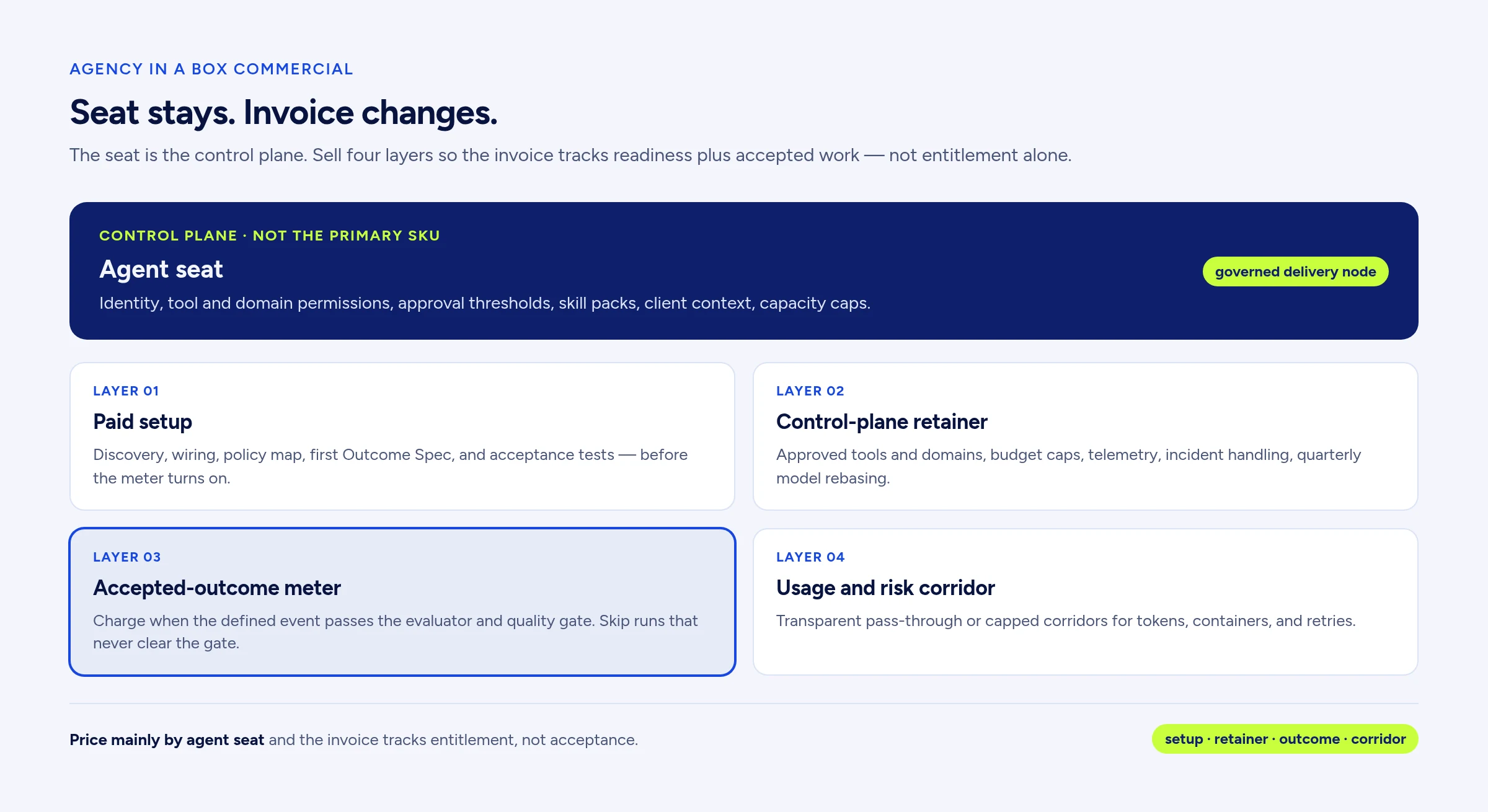
For an agency running Always On Agents, the seat stays. It is the control plane: identity, tool and domain permissions, approval thresholds, skill packs, client context, capacity caps. What changes is the invoice. Sell four layers.
1. Paid setup.
Discovery, wiring, policy map, first Outcome Spec, and acceptance tests. Scope and success metrics get written before the meter turns on.
2. Control-plane retainer.
Ongoing governance and readiness: approved tools and domains, budget caps, telemetry, incident handling, quarterly model rebasing when vendors ship another Flash-class release or change harness behavior. This is the floor that keeps the seat operable when platforms churn under you.
3. Accepted-outcome meter.
Charge when the defined event passes the evaluator and quality gate. Charge for work the client can verify. Skip billing for runs and attempts that never clear the gate.
4. Usage and risk corridor.
Transparent pass-through or capped corridors for tokens, containers, and retries. Without this rail, outcome pricing dumps failed-run economics on you with no visibility. With it, you choose how much retry risk to absorb versus show.
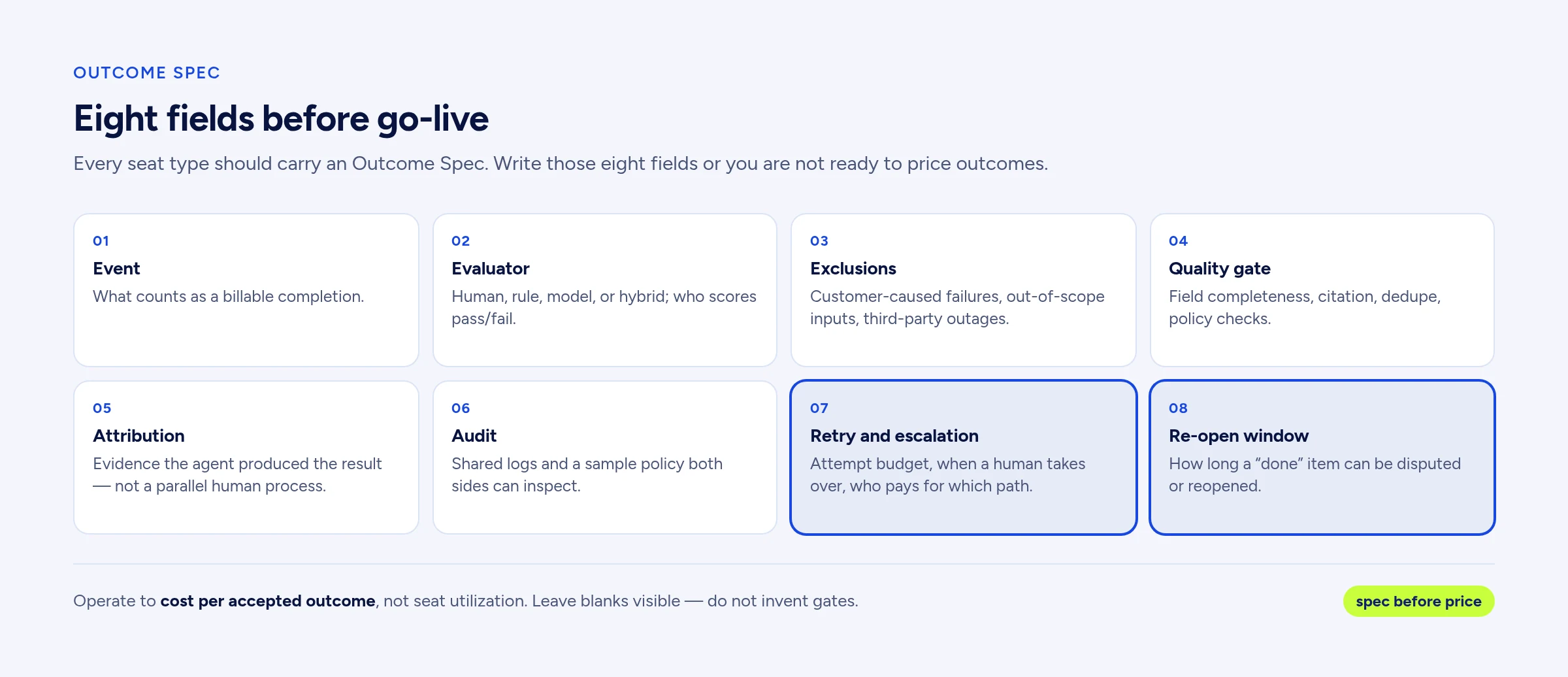
The Outcome Spec is the productized contract. Every seat type should carry one before go-live:
- Event. what counts as a billable completion (for example, a lead record that clears gates, or a ticket marked verified-resolved).
- Evaluator. human, rule, model, or hybrid; who scores pass/fail.
- Exclusions. customer-caused failures, out-of-scope inputs, third-party outages.
- Quality gate. field completeness, citation, dedupe, policy checks, whatever the vertical needs.
- Attribution. evidence that the agent (not a parallel human process) produced the result.
- Audit. shared logs and a sample policy both sides can inspect.
- Retry and escalation. attempt budget, when a human takes over, who pays for which path.
- Re-open window. how long a "done" item can be disputed or reopened.
Write those eight fields or you are not ready to price outcomes. Zendesk made verification billing infrastructure. Stripe says definition and dispute rules belong in the agreement.
Operate to cost per accepted outcome, not seat utilization. Instrument:
- fully loaded cost and human minutes per accepted outcome
- first-pass yield (accepted without retry)
- retries per accepted output
- escalation rate
- evaluator disagreement (grader vs human review)
Managed multi-agent fan-out makes retries cheap to start and expensive to ignore. Under an outcome meter, every failed tool call, extra branch, and false-negative grade hits margin. Under a hybrid corridor, you still need the same dashboard so you know whether the corridor is honest.
Boundary conditions matter. Seat-forward pricing still fits forecastable access packages, early pilots where the acceptance event is not yet stable, and procurement that will only approve named entitlements. Pure outcome meters fit poorly on subjective work such as strategy memos, brand direction, or open-ended design, where "done" is a judgment call. There, milestones with explicit acceptance criteria are safer than forcing a resolution event. Transactional seats (support containment, qualification, document processing) are where the Outcome Spec earns its keep.
Keep the seat. Reframe the commercial story. The seat is the governed delivery node. The invoice monetizes readiness plus accepted work. The evaluator and the contract compound across clients in a vertical. The generic agent loop does not.
Practical takeaway (Monday)
- Pick one transactional seat already in delivery. Write an Outcome Spec with the eight fields above. Leave blanks visible. Do not invent gates.
- Split the next proposal into setup + control-plane retainer + accepted-outcome line + usage corridor. Keep the seat on the architecture page, not as the primary SKU.
- Turn on the five operating metrics for that seat for two weeks before you publish a price. If first-pass yield and retry variance are unknown, the outcome price is a guess.
- Flag judgment seats (strategy/design) for milestone acceptance, not pure outcome meters.
- When citing market proof, keep Zendesk and Stripe as primary. Label any OpenAI completed-job story as reported and selective until OpenAI publishes terms.
If you want that commercial architecture wired into a real seat, Start your build or write hello@mail.22atlas.com.
Linked sources
- OpenAI Agents API overview: https://developers.openai.com/api/docs/guides/agents-api/overview
- Anthropic Projects redesigned: https://claude.com/blog/projects-redesigned
- Google Gemini 3.8 Flash: https://blog.google/innovation-and-ai/models-and-research/gemini-models/3-8-flash-and-3-8-flash-cyber/
- Zendesk automated resolution tiers: https://support.zendesk.com/hc/en-us/articles/9570369117338-About-automated-resolution-tiers
- Stripe outcome-based pricing guide: https://stripe.com/resources/more/outcome-based-pricing
- TNW / reported OpenAI outcome pricing: https://thenextweb.com/news/openai-outcome-based-pricing-enterprise
- Enterprise DNA retainer shape (packaging signal): https://enterprisedna.co/resources/ai-pulse/ai-pulse-2026-08-25-the-ai-implementation-agency-retainer-model-has-settled-into/
Get our Articles and posts by email.
Up to one email a day with new Articles and posts from 22atlas.com and sean-weldon.com, plus occasional news about 22Atlas services.