
The hard part stopped being "can an agent write a PR." It became "who owns the plan when ten of them run at once."

Mid-September, the tooling layer moved up a level. Cursor shipped Projects: a coordinator agent that does not write the code. It plans, delegates to cloud and local agents, keeps shared context across machines, and can subscribe to Slack, schedules, and PRs so work continues without another prompt. OpenAI put the Codex harness behind an Agents API in public beta the same week. Anthropic's Claude Code side is pushing the same shape with project threads that split one goal across parallel cloud sessions.
You can argue brands and betas. The product move is the same. Chat-sized agents were the last era. This era is a durable body of work with a coordinator on top.
What actually changed
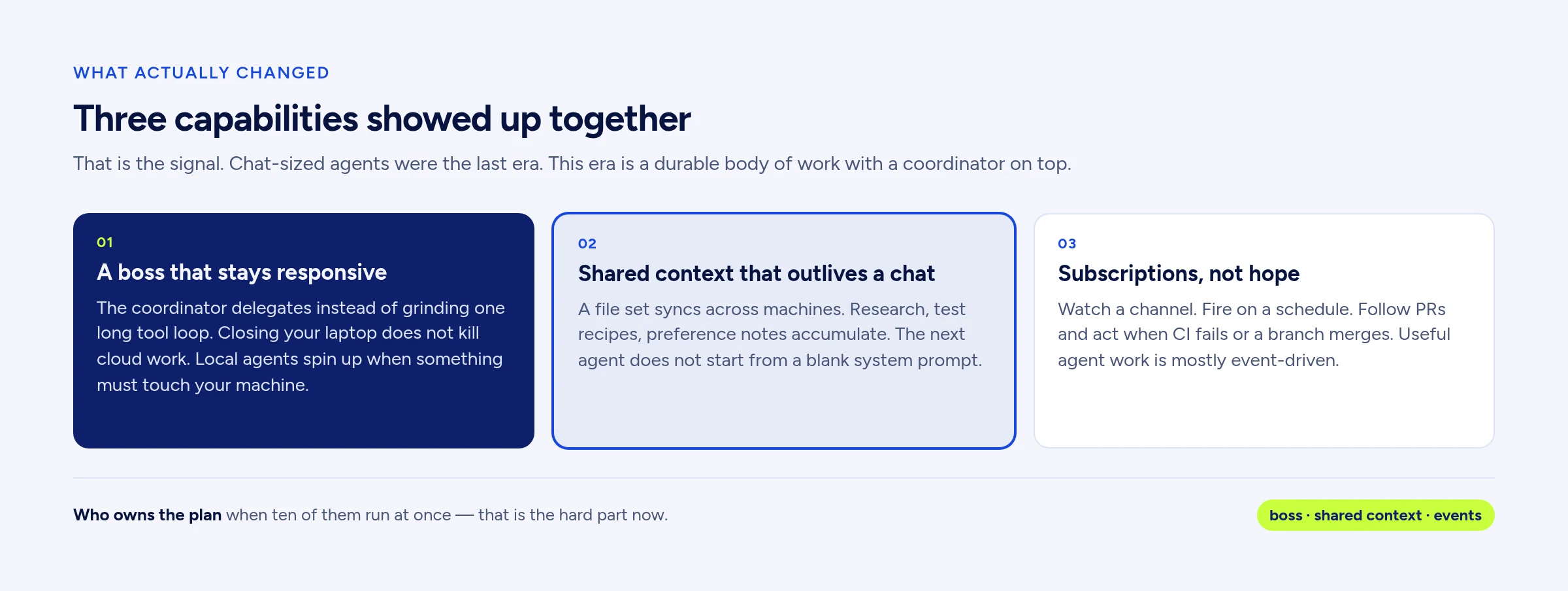
Three capabilities showed up together. That is the signal.
A boss that stays responsive. The coordinator delegates instead of grinding on one long tool loop. Closing your laptop does not kill the work when the fleet runs in the cloud. Local agents still spin up when something has to touch your machine.
Shared context that outlives a chat. Projects keep a file set that syncs across every machine the agents use. Research, test recipes, preference notes, and artifacts accumulate. The next agent does not start from a blank system prompt. That is the difference between a clever session and a seat that gets better across a migration.
Subscriptions, not hope. Watch a channel. Fire on a schedule. Follow PRs and act when CI fails or a branch merges. The product admits the truth operators already knew: useful agent work is mostly event-driven.
Cursor's own patterns map cleanly to agency work: feature pods, long migrations across many PRs, and gardening jobs that never really end (design-system drift, lint debt, regression watch). If your studio still treats agents as a one-off chat to unblock a ticket, you are one layer behind the tools your clients will buy next quarter.
What builders should do this week
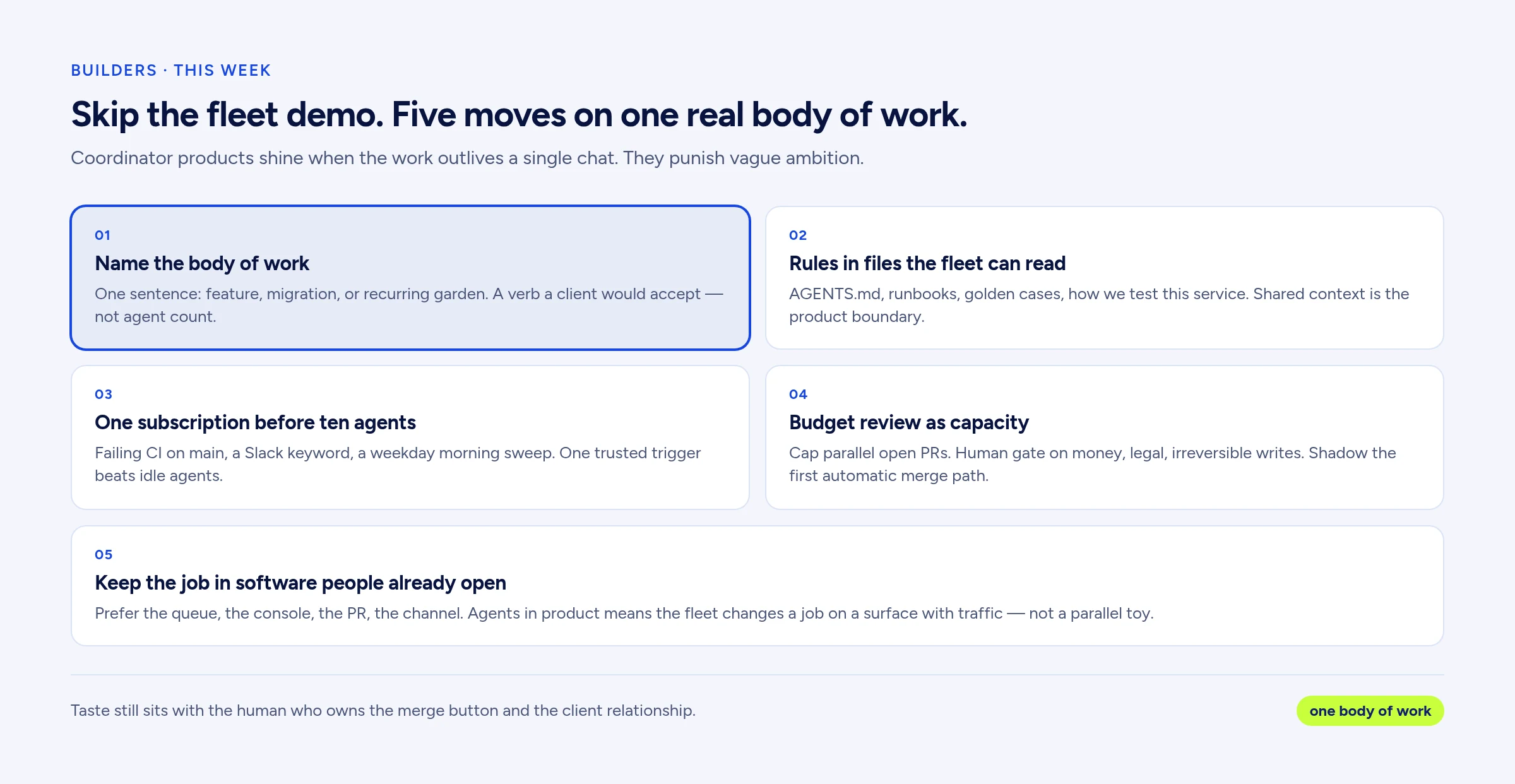
Skip the fleet demo. Do these five moves on one real body of work.
1. Name the body of work, not the agent count
Write one sentence: feature, migration, or recurring garden. If you cannot name the finish line in a verb a client would accept, more agents only multiply confusion. Coordinator products shine when the work outlives a single chat. They punish vague ambition.
2. Put the rules in files the fleet can read
AGENTS.md, runbooks, golden cases, how we test this service. Whatever your stack calls it, make the durable instructions a checked-in artifact. Chat memory is not a product boundary. Shared context is.
3. Wire one subscription before you wire ten agents
Pick the signal that already wakes a human: failing CI on main, a Slack keyword, a weekday morning sweep. One trusted trigger beats a dashboard of idle agents waiting for you to type again.
4. Budget review as capacity, not vibes
Cursor reports heavy PR volume once Projects stick. Your bottleneck becomes review, merge, and rollback taste. Cap parallel open PRs. Require a human gate on money, legal, and irreversible writes. Shadow the first automatic merge path the same way you would shadow any new write.
5. Keep the job in software people already open
A coordinator that only lives in a side IDE tab is still a demo. Prefer the queue, the console, the PR, the channel where the work already happens. Agents in product means the fleet changes a job on a surface with traffic, not a parallel toy.
What this is not
It is not fire 50 agents and go to lunch. It is not a license to skip a one-sentence definition of done. It is not a fake case study about 6x productivity on your client's repo. Vendor metrics are their story. Your story is whether a named slice got openable on a date someone will defend.
The coordinator layer makes long-running agent work cheaper to attempt. It does not make judgment free. Taste still sits with the human who owns the merge button and the client relationship.
Tell us which jobs you want off your plate.
If you want a lean pod that ships AI into the product people already use, not another fleet slide, Start your build or write hello@mail.22atlas.com. 22Atlas can take it from brief to something users can open.
Get our Articles and posts by email.
Up to one email a day with new Articles and posts from 22atlas.com and sean-weldon.com, plus occasional news about 22Atlas services.