
Skills this week. Argon on the watchlist until access opens.
On September 30, 2026, Google announced Gemini 4 Argon, its next frontier model. Google’s line: Argon is rolling out first to trusted cyber defenders through the Fairwind Program, with broader access planned for paid API customers and Google AI Ultra subscribers “as soon as possible.” Intro list is $2 / $10 per million input and output tokens, with cached input at 95% off input. After the intro period, $4 / $20 applies. Output headroom jumps to 1M tokens, up from 64K.
That reopens a three-way pricing triangle at the Sol / Sonnet list shape. It does not make Argon today’s default. Most teams cannot run it yet. The shippable move this week is Google’s Gems → skills kill calendar. Workspace Rapid Release for skills starts Monday, October 5, 2026.
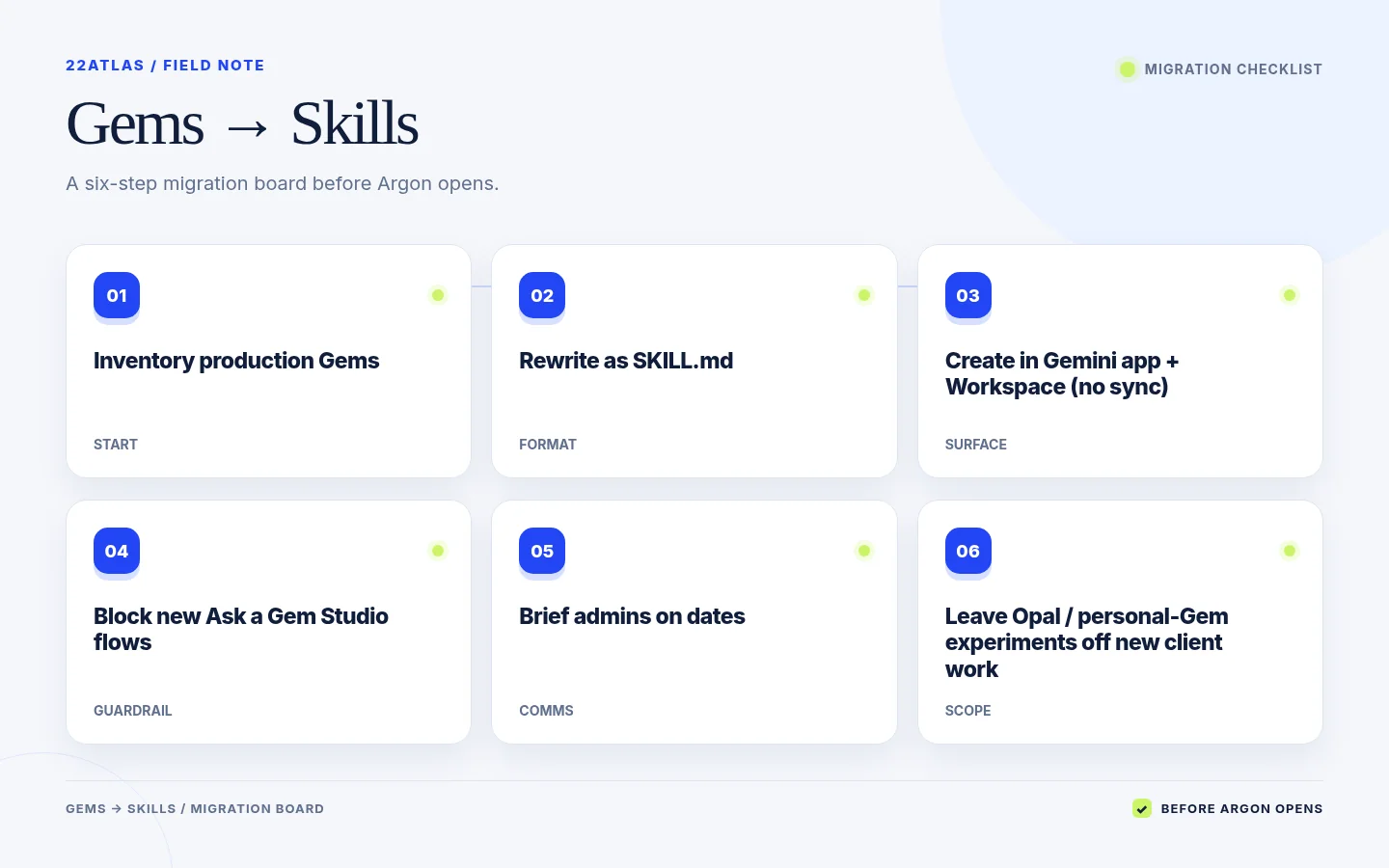
Inventory Gems, then recreate as SKILL.md
Skills are reusable custom instructions Google is rolling into the Gemini app and Workspace. They slash-invoke, stack in one prompt, take reference files, and sit on the open Markdown-native SKILL.md standard. Google’s product blog: “Skills are replacing Gems, and your existing data will migrate over automatically soon.” Auto-migrate is late and draft-quality risk for production brand-voice packs. Prefer a manual recreate for anything you ship to clients.
Skills do not sync between the Gemini app and Workspace. Create each skill in both surfaces if you need both.
Checklist before Rapid Release lands:
- Inventory every production Gem: brand voice, eval rubrics, client packs, review styles, ops runbooks.
- Rewrite each as a Markdown
SKILL.mdskill. Keep the instruction body portable so the same file can land in Gemini and in other Markdown-native skill folders later. - Create the skill in the Gemini app and again in Workspace. No sync means dual create is the rule, not a nice-to-have.
- Stop new Workspace Studio flows that use “Ask a Gem.” Google already blocks new Ask a Gem steps; existing flows keep working until the hard cut.
- Brief Workspace admins on the dates below. Point education seats at the education transition guide; business and enterprise seats at the Gems migration guide in Help Center.
- Leave Opal and personal-Gem experiments off new client work. Google says Opal turns down with personal Gems around the November window.
Do the inventory on one internal seat first. Then port the client packs you actually bill against.
Admin dates you should put on the wall
From Google Workspace Updates (2026-09-30):
- October 5, 2026: Skills begin in Workspace on Rapid Release domains (expected complete by October 12).
- October 13, 2026: Skills begin in the Gemini app (expected complete by mid-November).
- October 19, 2026: Skills begin in Workspace on Scheduled Release domains (expected complete by mid-November).
- November 17, 2026: Gems move into the Settings panel of the Gemini app; create, edit, and use still work.
- No sooner than March 1, 2027 (business and enterprise): Gems removed; Ask a Gem Studio flows stop; remaining Gems auto-migrate to draft skills.
- No sooner than June 1, 2027 (education): same hard cut for education surfaces, including Classroom and supported LMS paths.
Google says it will share auto-migration detail with admins at least 30 days ahead. Treat March 2027 as the business hard cut you plan against, not a soft rumor.
This is a vendor deprecation and migration beat. It is not a re-lead of suite-audit craft (SkillCascade stays on its own calendar slot). Decision layer here: port production instructions before the Rapid Release window, and do not build new Gem-dependent Studio paths.
Put Argon on the watchlist, not today’s default
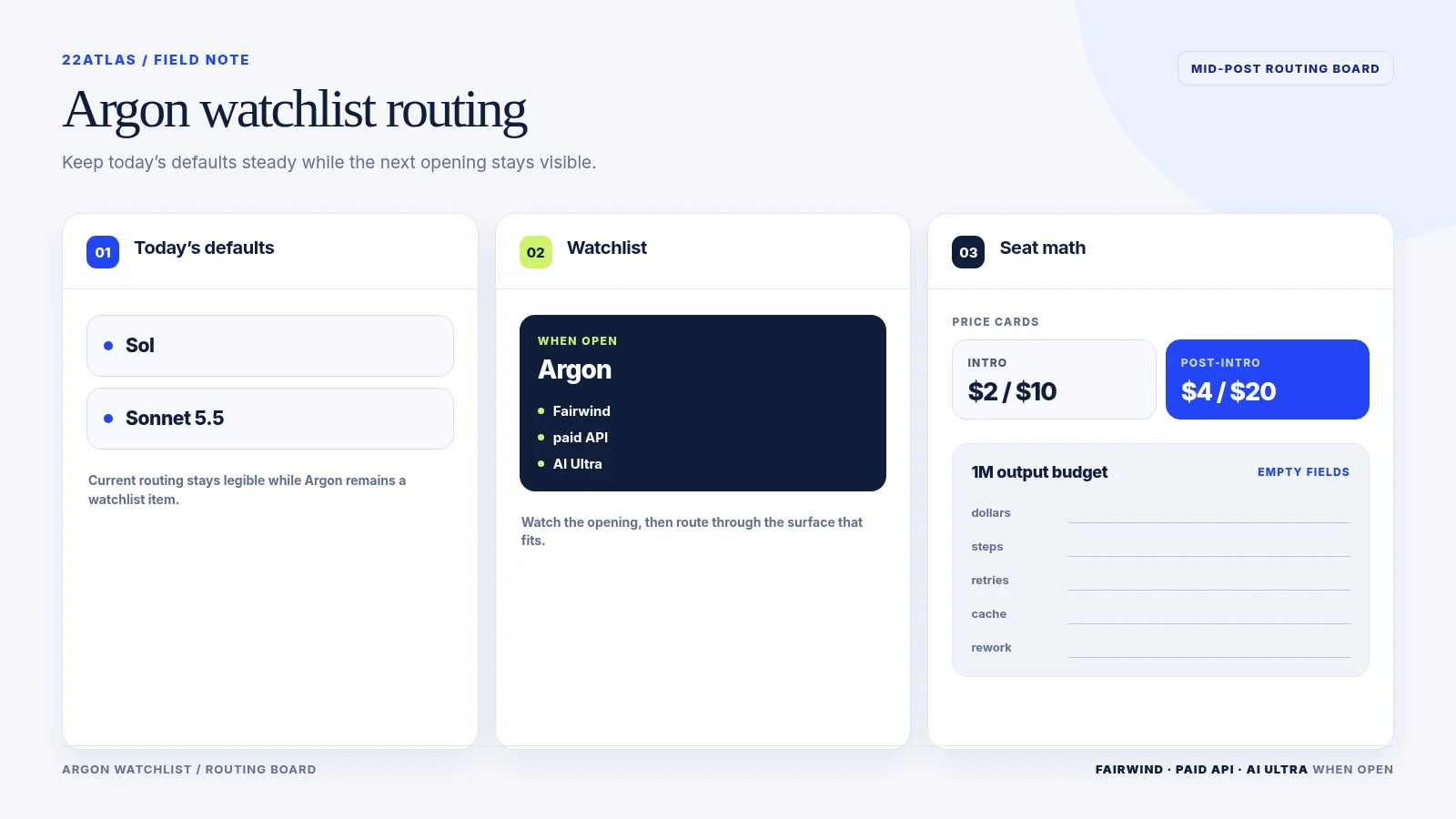
When paid API or AI Ultra access opens, Argon’s intro card matches the Sol / Sonnet $2 / $10 list shape, with a post-intro step to $4 / $20 and a 1M output token ceiling. Bake the post-intro price into seat math now so intro sticker does not set retainer floors.
Google-reported benches on the Argon page include DeepSWE v1.1 at 77.9%, AutomationBench at 51.3% (#1), a leading Vals Index read, CWE-bench v1 tied for first at 68%, and LVBench at 91.7%. Those are vendor numbers. Independent reproductions are still open. Remeasure on your own tasks before you rewrite defaults.
Routing stub for when access lands:
- Keep Sol (
gpt-6.1-sol) and Sonnet 5.5 as today’s dual-stack defaults. See the Sol and Sonnet workhorse notes for those flips. - Add Argon as a watchlist lane with the same coding and computer-use tasks you already score on Sol and Sonnet.
- Log dollars per task, steps, retries, cache hit rate, rework minutes, and output-token spend under the 1M cap.
- Score intro $2 / $10 and post-intro $4 / $20 as separate columns so the seat math survives the intro window.
- Flip any Google-side default only after your harness can call Argon and the scoreboard moves on your tasks.
Do not claim Argon as the agency default this week. Fairwind-first access is the access story Google published.
Fairwind-style access as the operator pattern
Google is shipping Argon’s strongest cyber-defense mode first to trusted defenders, with guardrail-free cyber mode reserved for that cohort and Google’s own teams, while it hardens safeguards for broader release. Anthropic’s Sep 29 research on GLM-5.3 frames the other side of the same week: an open-weight model Anthropic assesses as strong on autonomous end-to-end cyber exploit capability, downloadable without meaningful safeguards, with Anthropic reporting simple bypasses that engage between 64% and 100% of the time in its simulated tests. NIST CAISI (cited in that Anthropic post) called GLM-5.3 the most cyber-capable open-weight model released to date as of mid-September.
Decision only, no exploit recipes:
- Prefer vendor trusted-access programs (Fairwind / Glasswing-style) for defensive cyber work.
- Keep open-weight cyber-capable models out of client sandboxes unless you have a deny-by-default ACL, scoped tools, and an explicit client policy.
- Pair this with the deny-by-default browser note when any seat gets a browser or network path.
Phased access is the operator pattern. Open download without safeguards is the risk pattern.
Also on the desk
- GPT-6.1 Sol as the OpenAI workhorse. OpenAI default flip at the $2 / $10 list shape Argon is aiming at on intro.
- Sonnet 5.5 as the agency workhorse. Anthropic migrate-then-flip at the same list dollars.
If you want Gems ported to skills, Argon staged on a watchlist harness, and a governed AI development seat for Gemini / Workspace agent work, Start your build or write hello@mail.22atlas.com.
Linked sources
- Google: Gemini 4 Argon (2026-09-30)
- Google: Automate tasks with skills (2026-09-30)
- Google Workspace Updates: Skills in Gemini app and Workspace / Gems transition (2026-09-30)
- Anthropic Research: GLM-5.3 and the spread of advanced cyber capabilities (2026-09-29)
- Related Field note: GPT-6.1 Sol as the OpenAI workhorse
- Related Field note: Sonnet 5.5 as the agency workhorse
- Related Field note: Deny-by-default before you give the agent a browser
Get our Articles and posts by email.
Up to one email a day with new Articles and posts from 22atlas.com and sean-weldon.com, plus occasional news about 22Atlas services.
Also on the desk
Technique
GPT-6.1 Sol as the OpenAI workhorse
OpenAI’s DevDay upgrade nearly matches Astra on agentic coding and computer use at one-fifth Astra’s standard token prices (OpenAI-reported). Flip Codex and API agent traffic to gpt-6.1-sol this week; keep Astra for the hardest paths.
Technique
Sonnet 5.5 as the agency workhorse
Claude Sonnet 5.5 keeps Sonnet 5’s list price, cuts cost per task up to 30%, and runs 30%+ faster (Anthropic-reported). Claude Code already defaults Sonnet to 5.5. Migrate thinking, then flip traffic.