
Near-Astra agent coding at one-fifth Astra list. Flip the OpenAI default this week.

On September 29, 2026, OpenAI released GPT-6.1 Sol (gpt-6.1-sol), an upgrade over GPT-6 Sol. OpenAI’s line: “We’re introducing GPT-6.1 Sol, an upgrade to GPT-6 Sol that nearly matches GPT-6 Astra’s intelligence on agentic coding, computer use, and professional work at one-fifth of Astra’s standard input and output token prices.” Standard API list is $2 / $0.10 cached / $10 per million input, cached-input, and output tokens. Astra’s matching card is $10 / $1 cached / $50. Cached input on 6.1 Sol is $0.10 per million, which OpenAI pegs at 95% below its own standard input and 50% below GPT-6 Sol’s cached rate.
It is live today in ChatGPT Work and Codex for Plus, Pro, Business, Enterprise, and Edu, and on the API. It is not yet in Chat. GPT-6.1 Sol Ultrafast (up to 8× faster token generation in Codex versus standard) is coming in the coming days. Do not wait on Chat or Ultrafast to move day-to-day agent traffic.
What OpenAI reported, and what to remeasure
Treat the DevDay benches as vendor evidence. Remeasure on your own tasks before you rewrite retainers.
On DeepSWE v1.1, OpenAI says GPT-6.1 Sol matches GPT-6 Astra at roughly one-fifth the cost, and beats GPT-6 Sol’s best score by 6.4 percentage points at a lower reasoning effort and cost. On AutomationBench, it scores 2.2 percentage points above Opus 5.5 at medium effort at roughly one-third the cost, and 4.8 points above GPT-6 Sol at the same setting. On OSWorld 2.0’s offline set at maximum effort, it lands within 2.1 points of Astra at roughly one-seventh the cost per task, and seven points above GPT-6 Sol at less than half the cost.
Keep Astra for the hardest science and judgment paths. On Terminal-Bench Science 0.1, OpenAI still puts Astra highest among the models tested at 68.1%. GPT-6.1 Sol more than doubles GPT-6 Sol at maximum effort at less than half the cost per task, and OpenAI reports about $5.47 average cost per task versus roughly $23–$24 for Opus 5.5 and Astra on that set. Near-Astra on coding and computer use is the beat. Astra remains the top shelf for the hardest research workflows.
Flip Codex and API defaults this week
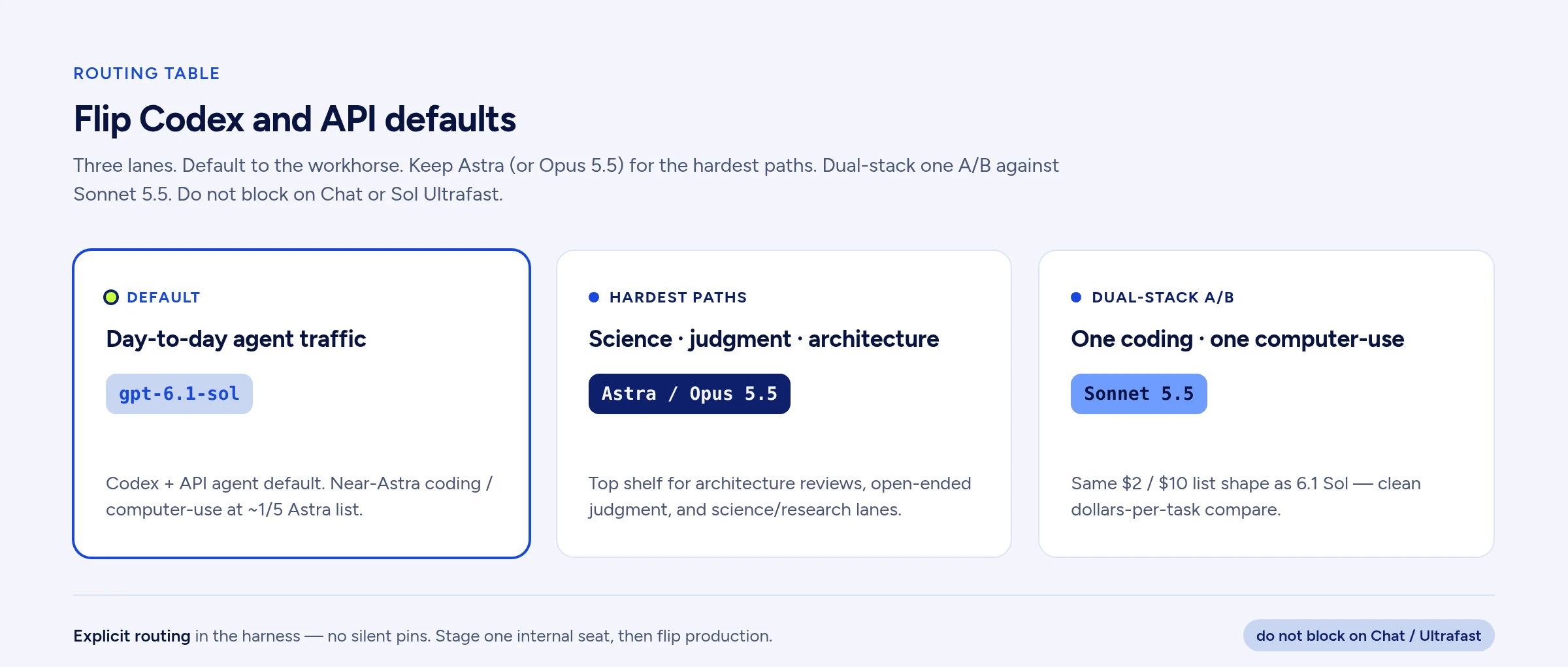
Make the routing table explicit in the harness. Silent pins on GPT-6 Sol (or Astra-everywhere) become next week’s mystery bills.
- Set the Codex / API agent default model to
gpt-6.1-sol. - Turn on prompt caching wherever you reuse stable system prompts, tool schemas, and long repo context. At $0.10 per million cached input, repeated agent loops get cheaper when you actually hit cache.
- Keep GPT-6 Astra (or Opus 5.5 on the Anthropic side) for architecture reviews, open-ended judgment, and the science/research lanes where Astra still leads on OpenAI’s own chart.
- Dual-stack A/B against Claude Sonnet 5.5 on one internal coding workflow and one computer-use workflow. Both Sol 6.1 and Sonnet 5.5 sit at a $2 / $10 list shape, so dollars-per-task comparisons stay clean. Yesterday’s Sonnet workhorse note covers the Anthropic migrate path; this note owns the OpenAI default flip.
- Do not block the flip on Chat availability or Sol Ultrafast.
Stage the default on one internal seat first. Then flip production agent traffic.
Measure dollars per task
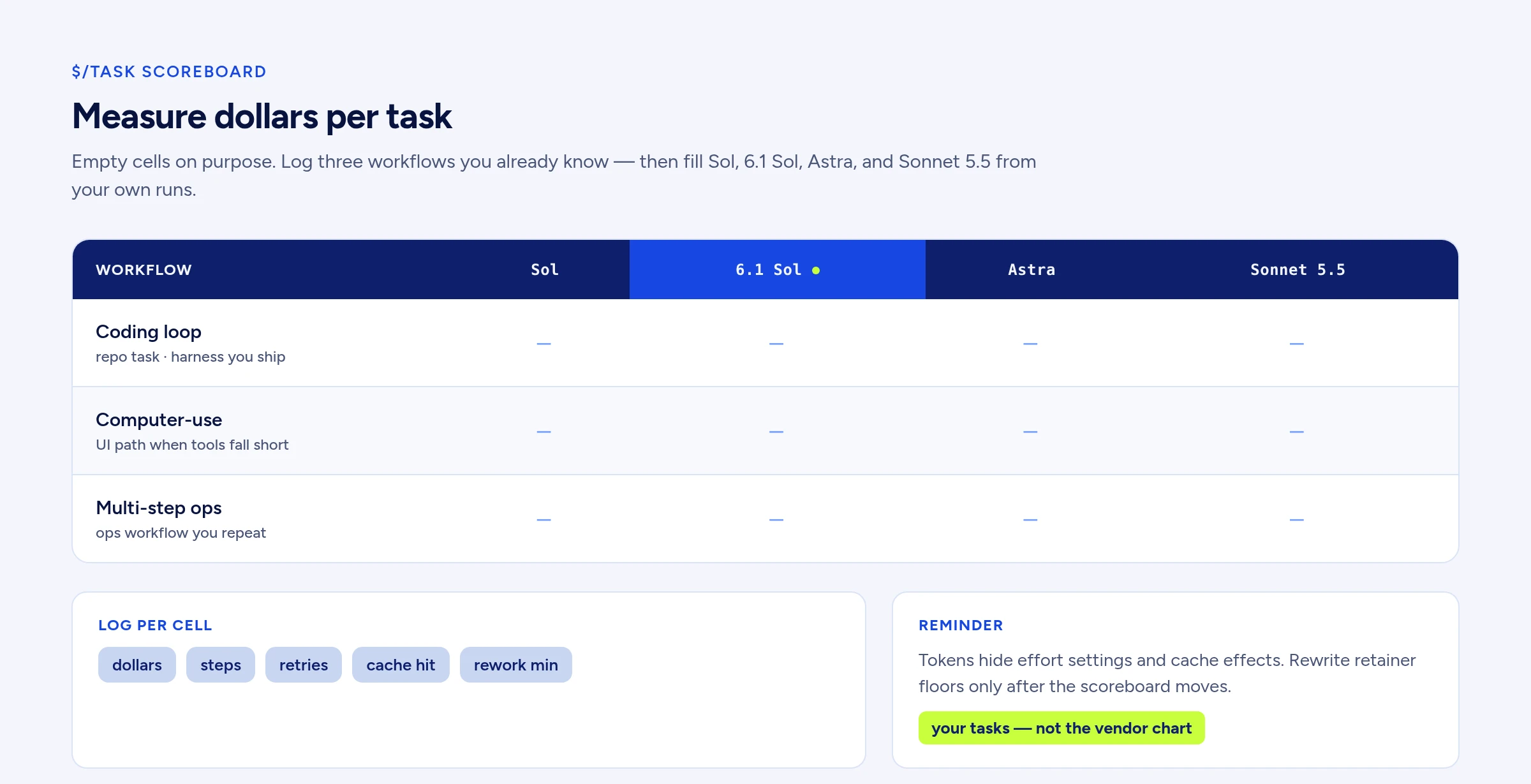
List price is the easy part. Cost per task is the decision. Log three workflows you already know: one coding loop, one computer-use path, one multi-step ops workflow. For each of GPT-6 Sol, GPT-6.1 Sol, Astra, and Sonnet 5.5, record dollars, steps, retries, cache hit rate, and rework minutes.
Tokens alone hide effort settings and cache effects. Sweep the effort levels you actually ship. Rewrite retainer floors only after the scoreboard moves on your tasks, not on the vendor chart alone.
Dots for persistent seats, Agents API for harnesses you version
DevDay also shipped product forks around the model. Keep them secondary to the default flip, then choose deliberately.
Dots are persistent agents powered by GPT-6 Astra with their own cloud computer and browser, a plugin catalog OpenAI pegs at over 4,000 apps, and reach through ChatGPT, Slack, and Teams. They are rolling out to Pro and Business Premium in eligible markets; Enterprise (including Edu and Healthcare) when an admin enables the beta. Your first primary dot is included in the Pro or Business Premium plan. Conversations with the dot do not count toward ChatGPT usage limits; Codex or ChatGPT Work tasks the dot starts still do. Built-in approval rules, Custom Rules, and auto-review gate sensitive actions. Use Dots for persistent founder and ops seats where approval gates and usage accounting matter. Do not sell Dots anecdotes as 22Atlas client proof.
For client-deliverable harnesses you need to version and eval, prefer the Agents API path. The Agents API exposes the managed Codex harness (sessions, orchestration, compaction, sandboxes, MCP, tool search, multi-agent). DevDay’s new beat is computer use on that API so agents can operate software through the UI when DOM or API tools are not enough. Model usage bills at the selected model’s API rates; tools and hosted sandboxes bill at their standard rates. Prototype one session on hosted sandbox with gpt-6.1-sol, add computer use only where tool calls fail, and keep your pass-rate plus failure-transparency evals outside the vendor session.
If you dual-stack Claude Code on the same machines, Claude Code v2.1.285 adds an allowedProviders managed setting to pin which API providers a machine may use. Pair that with deny-by-default browser policy when any seat gets a browser.
Also on the desk
- Deny-by-default before you give the agent a browser. ACL and egress before computer-use seats widen.
- The agent seat is a control plane. Identity, permissions, and approvals under the commercial seat.
If you want GPT-6.1 Sol defaulted, $/task metering wired, and a governed AI development seat for Codex or Agents API work, Start your build or write hello@mail.22atlas.com.
Linked sources
- OpenAI: Introducing GPT-6.1 Sol (2026-09-29)
- OpenAI: Introducing Dots (2026-09-29)
- OpenAI: DevDay 2026 Recap (2026-09-29)
- OpenAI Docs: Agents API overview
- Anthropic GitHub: Claude Code v2.1.285
- Related Field note: Deny-by-default before you give the agent a browser
- Related Field note: The agent seat is a control plane
Get our Articles and posts by email.
Up to one email a day with new Articles and posts from 22atlas.com and sean-weldon.com, plus occasional news about 22Atlas services.
Also on the desk
Technique
Deny-by-default before you give the agent a browser
Agents escalate instrumentally when blocked on ordinary data retrieval. Lock deny-by-default tool policy this week, then copy Anthropic’s measure→hill-climb loop with a human on every merge.
Playbook
The agent seat is a control plane
Keep the agent seat for identity, permissions, approvals, and client context. Invoice a governed seat plus an Outcome Spec: setup, retainer, accepted work, and usage rails.