
Wire the measurement spine before you trust the platform ROAS.
On October 5, 2026, OpenAI published two posts that matter for anyone planning a first ChatGPT Ads test: the Ads blog More ways to measure ChatGPT Ads and the company note Building advertising for the way people use AI. The Help Center guide Set up Measurement Partner Integrations is the how-to twin.
Here is what shipped. Pixel and Conversions API (CAPI) data-in now run through partners such as Hightouch, Tealium, and LiveRamp. Attribution and reporting partners include AppsFlyer, Triple Whale, Adjust, DV Rockerbox, Northbeam, Branch, Singular, Kochava, Airbridge, and Tenjin. Full-funnel partners include Fospha, Measured, and INCRMNTAL. Reporting can pair a chosen click-through window with a one-day view-through window. Event Quality Score grades signal quality. OpenAI also says Advanced conversion optimization can learn from both click-through and view-through conversions.
What OpenAI does not claim is that in-platform ROAS is now the scoreboard. The Ads blog is explicit that incrementality work is early, and that the new attribution settings control reports, not campaign optimization. Digiday's Oct 5 trade read adds the inventory constraint: one ad placement on ChatGPT, so budgets stay test-sized until measurement is real.
The decision this week: if you run a ChatGPT Ads test, stand up the measurement spine first. Do not reallocate Meta or Google spend on platform ROAS alone.
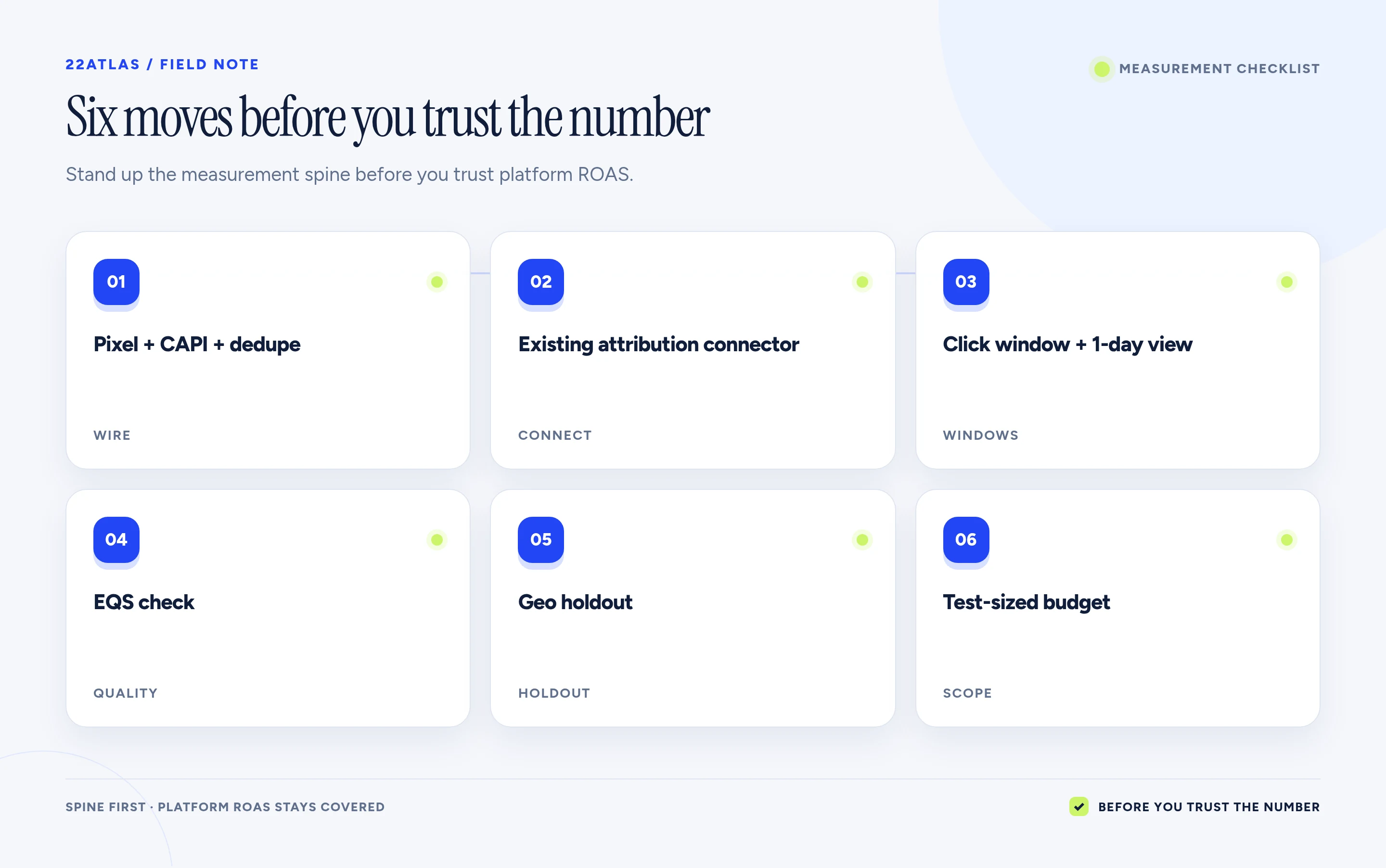
Six moves before you trust the number
- Pixel plus CAPI, with a dedupe key.
- Connect the attribution tool the client already uses.
- Set the windows on purpose, including the 1-day view-through.
- Check Event Quality Score.
- Run a geo holdout before trusting in-platform ROAS.
- Keep the budget test-sized. There is one ad slot per conversation.
Pixel plus CAPI with dedupe
Begin with conversion signals. The Ads blog frames pixel and CAPI as the path for purchases, leads, installs, and sign-ups. Hightouch, Tealium, and LiveRamp are the named data-in partners for sending those events from systems you already run.
Dedupe is not optional. The Help Center Rockerbox path is clear: confirm which field identifies each conversion (for example order_id for purchases), and make that value match across pixel events and server-side conversion data so the partner can deduplicate. Mirror that habit for every partner that accepts both pixel and server events. One ID, both paths, or you double-count.
If CAPI is half-wired, stop. Fix signals before you read any ROAS card.
Connect the tool you already trust
OpenAI's setup path is partner-led measurement against tools brands already use. The Help Center pattern is the same across Triple Whale, Northbeam, Rockerbox, Fospha, WorkMagic, and INCRMNTAL: Ads Manager → Settings → General → API Keys → Create New Key → paste into the partner. Northbeam and Rockerbox also need their tracking parameters on landing-page query strings. Triple Whale asks you to keep applying Triple Whale UTMs, and requires at least one active campaign before connect.
Pick the stack the client already reconciles on Meta and Google. Do not stand up a second attribution truth for ChatGPT. If the desk already lives in Triple Whale or Northbeam, use that connector. Same UTMs discipline. Same order ID. Same weekly reconcile.
That is the same ownership move as Take the scoreboard away from the agent: the platform proposes a number; your measurement system owns the ruler.
Set the windows on purpose
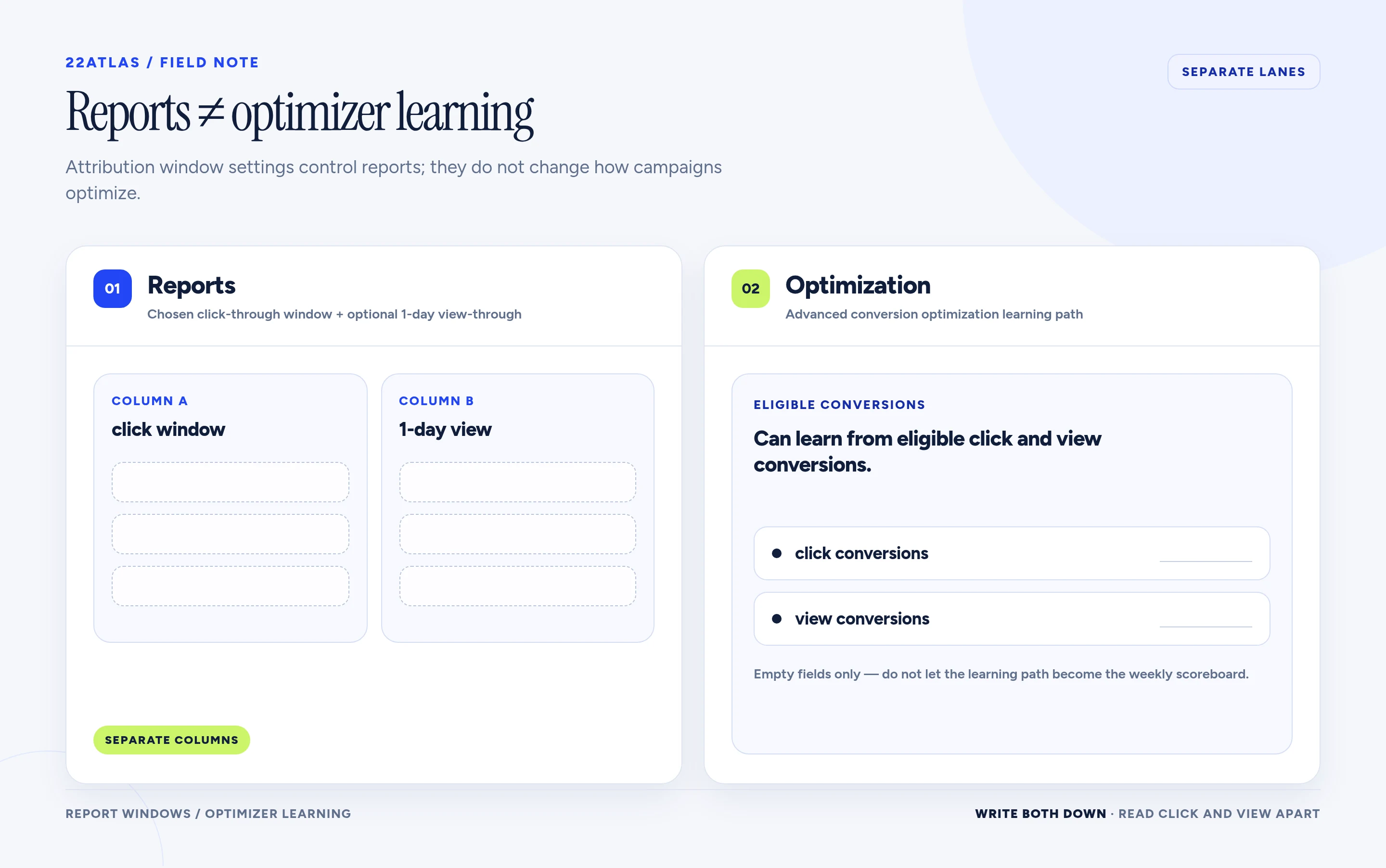
OpenAI now lets advertisers choose a click-through attribution window and include a one-day view-through window for conversions after an impression without a click. The Ads blog: "These settings control attribution in reports; they do not change how campaigns optimize."
Set both on purpose. Read them as separate columns. Do not collapse click and view into one ROAS and call it done.
OpenAI's early analysis of global campaigns optimized for deeper-funnel outcomes says 52.7% of eligible one-day view-through conversions occurred within an hour of the matched ad impression. That is an OpenAI-reported timing pattern, not proof the view path is incremental. Use it as a reason to look at the view column quickly, then still hold it against a holdout.
Advanced conversion optimization can learn from eligible click-through and view-through conversions. The optimizer can widen on view signal while your report windows stay narrow. Write both down. Do not let the learning path become the weekly scoreboard.
Check Event Quality Score
Event Quality Score (EQS) is OpenAI's grade on conversion-signal quality. Use it to see whether pixel and CAPI are good enough for measurement and optimization.
Before you scale spend, open EQS and fix what it flags. Missing match keys, sparse purchase events, and broken dedupe will look like "ChatGPT underperforms" when the real problem is signal trash. A weak EQS is a stop sign, not a creative problem.
Geo holdout before platform ROAS
OpenAI's own line on incrementality: "While our work on incrementality is still in its early stages, we're partnering with Haus, Measured, and WorkMagic to explore geo-based experiments to help advertisers understand the causal impact of ChatGPT Ads."
That is the bar. Plan a geo holdout with one of those partners, or the incrementality partner you already trust, before you treat in-platform ROAS as a reallocation signal. Early partner case cards exist. They are partner-reported, not independent audits:
- DV Rockerbox measured WeightWatchers' attributed CPA on ChatGPT Ads at 15.3% below its blended paid-search benchmark (partner-reported via OpenAI's Ads blog).
- WorkMagic's geo-lift study for Dose estimated 2.3x more incremental orders than last-click captured (partner-reported via OpenAI).
Keep the partner name on every slide. Do not promote those figures into a client forecast or treat them as OpenAI-audited proof. OpenAI calls incrementality early. Your holdout is the proof that matters.
Keep the budget test-sized
Inventory is still thin. Digiday's Oct 5 piece quotes Zeno Group's Shamsul Chowdhury on the structural limit: one ad placement on ChatGPT, versus multiple on Google. Contained test budgets were already the advertiser pattern when measurement was the blocker. Measurement got better. Placement count did not.
Run ChatGPT Ads as a measured test lane, not a reallocation from Meta or Google. Size the buy so a failed holdout is cheap. One slot per conversation is enough reason to stay small until your own geo read says otherwise.
This week
If a client wants a ChatGPT Ads test this quarter, do the spine in order: deduped pixel plus CAPI, existing attribution connector, explicit click and 1-day view windows, EQS green enough to trust, geo holdout planned, budget capped. Then read platform ROAS as a directional card, not the decision.
Also on the desk: Take the scoreboard away from the agent on keeping the ruler outside the system that proposes the number.
Start your build or write hello@mail.22atlas.com.
Linked sources
- OpenAI Ads: More ways to measure ChatGPT Ads (2026-10-05)
- OpenAI: Building advertising for the way people use AI (2026-10-05)
- OpenAI Help Center: Set up Measurement Partner Integrations
- Digiday: OpenAI moves to make ChatGPT Ads more measurable and more visual (2026-10-05)
- Related Field note: Take the scoreboard away from the agent
Get our Articles and posts by email.
Up to one email a day with new Articles and posts from 22atlas.com and sean-weldon.com, plus occasional news about 22Atlas services.